Executive Summary
The white powder on exterior stone is most commonly efflorescence—soluble mineral salts carried to the surface by moisture moving through stone, mortar, grout, or concrete and left behind when the water evaporates. The definitive resolution is to remove the residue using stone-safe, low-moisture methods and then eliminate the moisture pathway (sprinklers, runoff splash, drainage/grade issues, missing capillary breaks, or failed joints) so it stops returning.
3 Core Insights
- It’s a moisture-transport problem, not just “dirty stone”: Efflorescence forms when water repeatedly enters the masonry, dissolves salts, migrates through pores/joints, and evaporates at the face—so recurrence means the water source is still active.
- Correct identification prevents permanent damage: Efflorescence is usually powdery and removable, while etching and some bonded residues are not—using acids or aggressive washing on acid-sensitive stone (like limestone/travertine) can permanently dull or damage the surface.
- Dry-first cleaning plus moisture control is the durable fix: Start with dry brushing and minimal-water rinsing, escalate only with material-appropriate cleaners if needed, and prioritize irrigation/runoff/drainage and joint repairs to stop salts from being transported back to the surface.
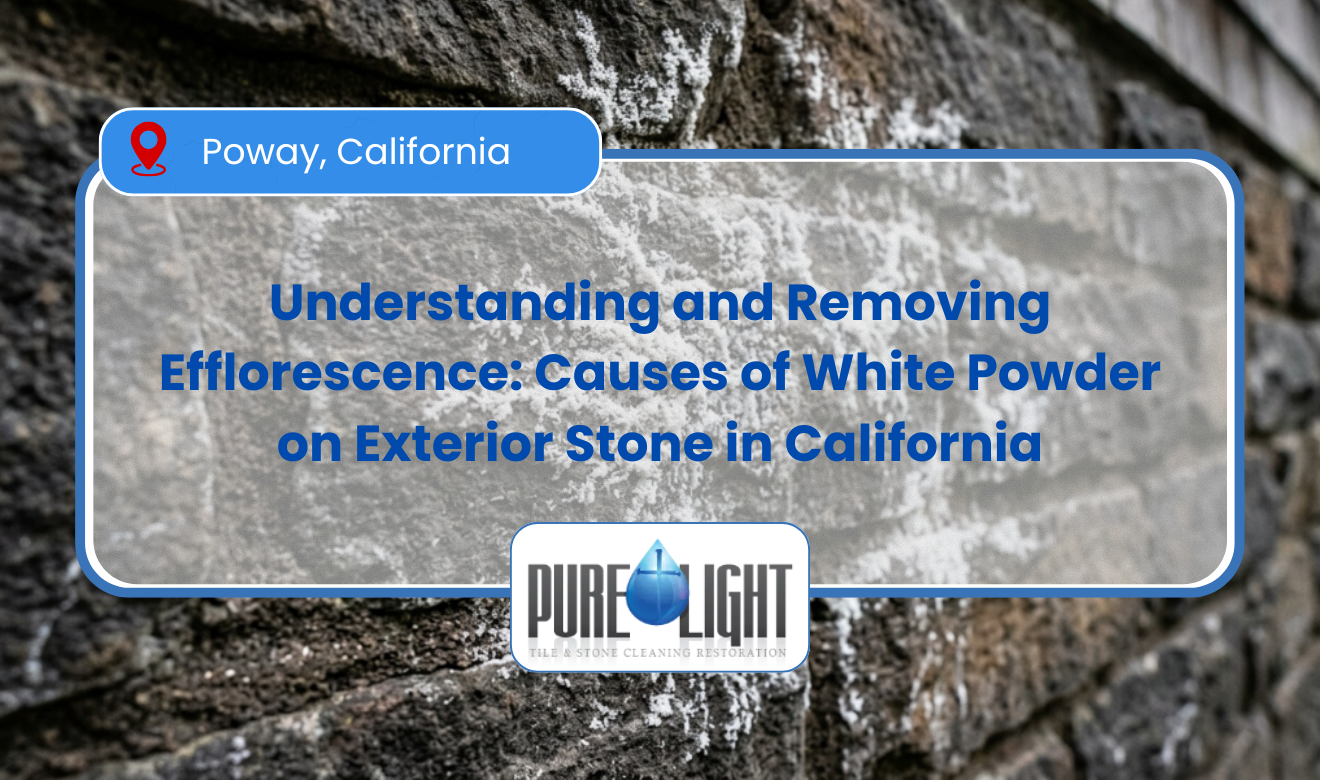
Efflorescence is a white, chalky powder made of mineral salts that migrate through masonry and dry on the surface. When homeowners ask, “what is this white powder on my exterior stone,” the most common answer in California is salt deposits pulled out by moisture moving through stone, mortar, or grout. This often shows up on porous materials like limestone, sandstone, concrete pavers, manufactured stone veneer, and mortar joints. You may see it after winter rain in the Bay Area, dense coastal fog along the Central Coast, or heavy irrigation cycles in Southern California yards. It also appears where sprinklers hit a wall daily, where downspouts splash near a stone façade, or where a capillary break is missing under a stone ledge.
Why exterior stone develops a white powdery film
That white haze is almost always mineral salt crystallization caused by water moving through masonry and evaporating at the surface. The deposits can originate from the stone, the mortar or grout, concrete backing, or the soil and irrigation water around the installation.
Efflorescence forms through a consistent, predictable mechanism:
- Water enters the assembly (rain, sprinklers, fog-driven wetting, capillary rise, leaks).
- Salts dissolve into that water (alkali salts, calcium compounds, or mixed soluble salts).
- Moisture migrates through pores, microcracks, mortar joints, or weep paths.
- Water evaporates at the surface, leaving the salts behind as a white powder or crust.
In California climates, the cycle accelerates during wet nights and fast daytime dry-outs, as well as in coastal zones where intermittent mist repeatedly wets and dries the façade.
Efflorescence vs. other white stains: how to tell what you’re seeing
Efflorescence is typically removable salt residue on the surface, while other white marks can be mineral etching, hard-water scale, or cementitious haze bound to the material. Correct identification matters because acid or aggressive cleaning can permanently damage limestone, travertine, marble, and some manufactured stone veneers.
Use these field indicators to narrow it down before choosing a cleaning method:
- Efflorescence (soluble salts): powdery, often wipes off dry with a finger; reappears after moisture events; concentrated near joints, ledges, grade lines, and drip edges.
- Hard-water mineral scale: common under sprinklers and hose bibs; forms a tighter crust; often follows water run patterns; may include calcium carbonate.
- Cement haze / grout film: appears soon after installation; can look cloudy rather than powdery; often uniform across faces of stone or pavers.
- Etching on calcite-based stone: looks dull or lightened but is not a removable powder; it is surface damage, not a deposit.
- Paint/ stucco overspray or construction dust: tends to be more uniform and not concentrated at moisture pathways.
If the film disappears when brushed dry and returns after irrigation or rain, that strongly points to salt migration rather than etching or permanent discoloration.
California-specific moisture pathways that trigger salt deposits
Most repeat efflorescence is a building-water-management issue, not a “dirty stone” issue. When you eliminate the moisture source and allow the assembly to dry, the deposits typically stop forming.
Common local causes on exterior stone façades, pavers, and landscape walls include:
- Sprinkler overspray and rotor misting: daily wetting is enough to keep salts dissolving and re-crystallizing on stone faces.
- Downspout discharge and splash-back: roof runoff concentrates minerals at the base of walls and on adjacent pavers.
- Missing capillary breaks: stone caps, ledgestone, and retaining walls without separation layers can wick moisture from below.
- Poor drainage or negative slope: water collects at the wall/paver edge, saturating the bedding and joints.
- Unsealed or failed joints: cracks at coping, window sills, or penetrations allow water into the wall assembly.
- New cementitious materials curing: fresh mortar, thinset, and concrete release soluble compounds during early cure cycles.
- Coastal wetting cycles: fog and wind-driven rain can repeatedly wet porous stone without obvious “storms.”
When homeowners ask what is this white powder on my exterior stone, the most consistent answer is “water is moving through the system somewhere,” and the fix begins with tracking that route.
Risk management: what not to do on limestone, sandstone, and manufactured veneer
Many DIY approaches make the problem worse by increasing porosity, etching the surface, or forcing salts deeper into the stone. The wrong chemical can permanently change sheen, texture, and color—especially on calcite stones.
Avoid these high-risk actions unless a stone-safe process has been verified:
- Do not use muriatic acid on limestone, travertine, marble, terrazzo, or any calcite-based stone; it reacts with calcium carbonate and causes etching.
- Do not pressure wash aggressively on soft stone or mortar joints; high pressure erodes joint faces and opens pores for more water intrusion.
- Do not seal over active efflorescence; trapping moisture behind a coating can intensify crystallization pressure and cause spalling.
- Do not wire-brush soft stone; metal abrasion can leave streaking and permanently roughen the face.
- Do not “bleach it”; bleach does not dissolve most salts and can discolor adjacent materials and landscaping.
For any veneer or adhered stone installation, also avoid flooding the wall during cleaning. Excess water is the transport mechanism for salts.
Step-by-step: a safe, practical removal process for most exterior stone
Effective removal is based on dry methods first, minimal water second, and targeted chemical use only when the stone type allows it. The goal is to remove surface salts without driving new moisture into the assembly.
- Confirm the stone and joint type. Identify whether the surface is limestone/travertine (acid-sensitive), sandstone, slate, granite, concrete pavers, or manufactured stone veneer.
- Start dry. Use a soft nylon brush or microfiber cloth to remove loose powder; collect residue so it does not re-dissolve during rinsing.
- Use low-moisture rinsing. Lightly mist and wipe rather than soak; repeat with clean water to avoid re-depositing salts.
- Escalate only if needed. If the deposit is bonded (crusty), use a stone-appropriate cleaner based on the material:
- Acid-sensitive stone (limestone/travertine/marble): use non-acid, stone-safe efflorescence removers designed for calcite surfaces.
- Concrete pavers and some hard stone: mild acid-based cleaners may be appropriate, but only with controlled dwell time and thorough neutralization per product directions.
- Neutralize and rinse correctly. If any acidic chemistry is used on acid-tolerant surfaces, neutralize as directed to prevent ongoing reactions.
- Allow full drying. Give several dry days (weather-dependent) before evaluating results; salts can continue migrating while moisture remains inside.
If deposits keep returning, treat it as a moisture intrusion diagnosis problem rather than repeated cleaning. In many cases, targeted Exterior Stone Cleaning is used after correcting drainage, irrigation patterns, or joint failures so the surface stays clean longer.
Moisture-source fixes that stop repeat outbreaks
Cleaning removes residue, but controlling water is what prevents recurrence. The corrective action usually involves irrigation adjustment, drainage correction, joint repair, and allowing the assembly to vent and dry.
High-impact fixes used on California homes include:
- Adjust irrigation: redirect sprinkler heads, reduce overspray, and avoid daily wetting of stone façades and retaining walls.
- Manage roof runoff: extend downspouts to discharge away from stone and paver areas; reduce splash zones with drains or rock beds.
- Improve grade and drainage: maintain slope away from walls; add drainage where water ponds near masonry.
- Repair joints and flashing transitions: seal failed caulk lines at coping, sills, and penetrations using exterior-rated sealants compatible with masonry.
- Address capillary rise: where feasible, add capillary breaks under caps/ledges or rebuild details that continuously wick moisture.
- Avoid film-forming coatings on damp walls: trapped moisture can increase crystallization pressure behind the surface.
When water movement is reduced, salt transport slows dramatically and the powdery film typically stops forming.
Key specifications and local best practices (California)
The most reliable approach combines recognized building-water-management principles with material-appropriate cleaning. Where a repair changes drainage or involves wall waterproofing, align the work with standard code intent for weather protection and drainage.
| Feature / Metric | Specifications | Local Guidelines |
|---|---|---|
| Primary cause mechanism | Water dissolves soluble salts; salts migrate through pores/joints; crystallize after evaporation | Prioritize irrigation control and drainage around façades, retaining walls, and paver systems |
| Acid sensitivity (calcite stones) | Limestone/travertine/marble etch when exposed to acidic cleaners | Use non-acid stone-safe products; avoid muriatic acid commonly used on concrete |
| Best first removal method | Dry brush/vacuum; minimal-water wipe-down; repeat as needed | Schedule cleaning during a dry weather window to allow full drying between steps |
| Common recurrence zones | Base of walls, near joints, under caps/ledges, splash zones, and planters | Check sprinklers, downspouts, planter waterproofing, and grading first |
| Code intent reference | Exterior walls must resist weather and prevent water intrusion into the building envelope (CBC/CRC adoption of IBC/IRC principles) | For leak-driven efflorescence, repairs should restore positive drainage and weather-resistive detailing consistent with permitted construction practices |
When the “white powder” signals damage instead of a removable residue
Some salt activity is cosmetic, but persistent moisture and crystallization can physically break down masonry over time. If you see surface flaking or crumbling, treat it as a durability problem, not just staining.
Escalate to a more thorough assessment when you observe:
- Spalling or pop-outs: the face of stone, brick, or mortar breaks away in chips.
- Soft or sandy mortar joints: joints erode when brushed, indicating water-related deterioration.
- Rust-colored staining with white deposits: can indicate metal lath corrosion behind adhered veneer.
- Interior-side symptoms: damp drywall, bubbling paint, or musty odors near the stone wall.
- Efflorescence concentrated at cracks: suggests water entry points that need sealing or flashing correction.
These conditions often require repair of the assembly details (drainage plane, flashing, weeps) rather than repeated surface cleaning.
How maintenance routines reduce repeat salt deposits
Simple maintenance controls the two variables that drive efflorescence: water exposure and available soluble salts. A predictable routine prevents heavy buildup that later requires aggressive methods.
Use a maintenance plan built around low-moisture cleaning and early intervention:
- Monthly visual checks at sprinkler-hit zones, downspout outlets, and along the first 12–24 inches above grade.
- Dry removal first whenever a light powder appears; don’t wait for it to harden into a crust.
- Prompt drainage corrections after landscape changes or new irrigation programming.
- Joint and grout inspections on adjacent tile/stone transitions; failing joints are water entry points. For deeper cleaning of surrounding hard surfaces and joints, use guidance consistent with San Diego grout cleaning best practices so residues aren’t spread onto porous stone.
For pavers, also keep polymeric sand and joint fill in good condition; open joints increase water infiltration into the bedding layer where salts often originate.
A clear takeaway: identify, remove, and prevent
The white powder on exterior stone in California is most often efflorescence: salts transported by moisture and deposited during evaporation. The durable fix is a two-part approach—remove the residue safely for the stone type, then stop the moisture pathway that keeps feeding it.
To resolve the issue with the least risk of damage:
- Confirm the surface (especially whether it is acid-sensitive limestone/travertine/marble).
- Remove deposits using dry-first, low-water methods to avoid driving salts deeper.
- Correct the water source (irrigation overspray, runoff splash, missing capillary breaks, drainage or joint failures).
- Reassess after a full dry-out period to verify the cycle has stopped.
When identification is uncertain or buildup is recurring, treat it as a moisture-management problem first and a cleaning problem second—because moisture transport is the underlying reason the deposits appear in the first place.
Frequently Asked Questions
Stop the White Powder at the Source (Before It Turns Into Permanent Damage)
Efflorescence isn’t just an “ugly haze” you can rinse away—it’s a flashing red warning that water is moving through your stone, mortar, or grout. And in California’s wet/dry cycles, that moisture path can keep feeding salts back to the surface again and again, even after you clean it.
Here’s the real risk of handling this without an experienced local pro: the most common DIY fixes (high-pressure washing, over-wetting, sealing too soon, or using the wrong cleaner) can force salts deeper, etch acid-sensitive stone like limestone or travertine, weaken mortar joints, and even contribute to spalling and surface breakdown. In other words, you can spend a weekend “cleaning” and end up accelerating the very damage you were trying to prevent—then pay more later to repair it.
We approach it the right way: identify what the white residue actually is, remove it with stone-appropriate methods, and help you pinpoint the moisture pathway that’s feeding the problem—sprinklers, runoff splash, missing capillary breaks, drainage issues, or failing joints—so it doesn’t just come back after the next rain or irrigation cycle.
If you want the fastest path to a clean exterior stone surface that stays clean, get a local expert involved before the deposits harden, the stone gets etched, or the joints start deteriorating.